You have just found your dream prospect, exactly the kind of brand your creative agency has always wanted to work with, and you have pinpointed the right decision-maker to approach. Then comes the moment of sending that first message, and with it the familiar doubt: does cold email even work any more? It is an understandable hesitation. Between LinkedIn pitches, paid outreach and a constantly full inbox, it is easy to assume cold email is past its best and destined for the junk folder. The reality is more encouraging. Email remains one of the most effective ways for an agency to open a conversation with a brand it wants to win, and when it is done with genuine precision and relevance, a cold email does far more than land in an inbox; it opens a door.
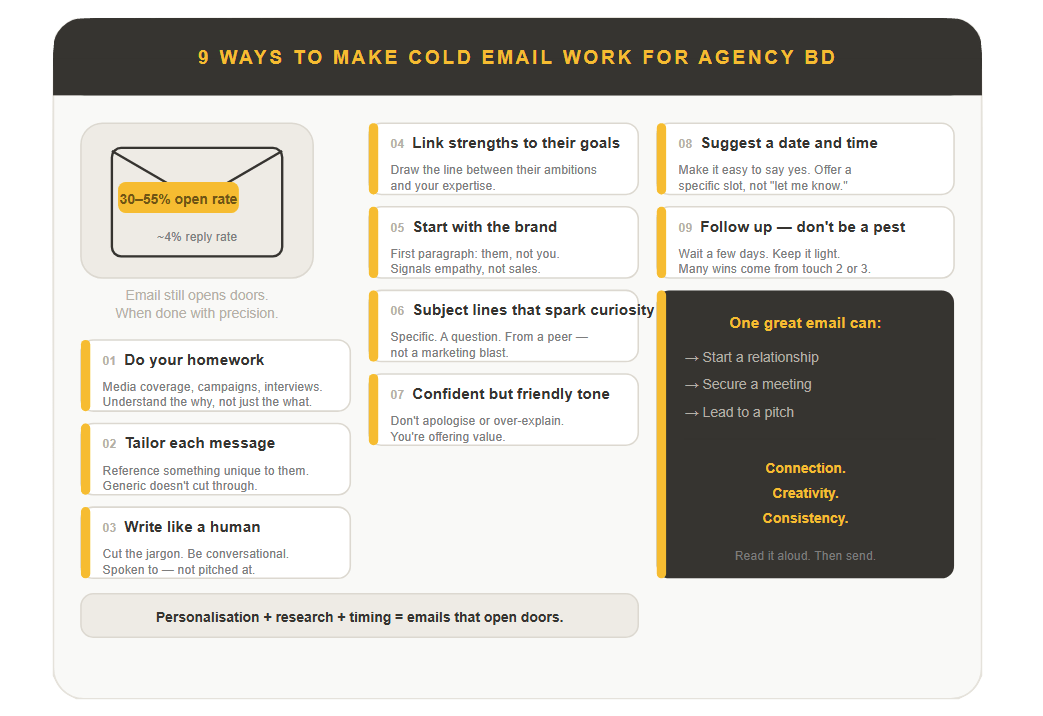
Why Email Still Matters In Agency New Business. For all the newer channels competing for attention, email continues to perform. Open rates typically sit somewhere between 30% and 55%, with reply rates around 4%, and at the scale agency new business operates on, those numbers are more than enough to break into accounts that matter. The difference between an email that works and one that vanishes comes down to three things: research, personalisation and timing. Cold outreach and impersonal outreach are not the same thing, and the agencies that treat them as if they were are usually the ones who conclude that email is dead.
Nine Ways To Make Cold Emails Work. A cold email that earns a reply is rarely an accident. The agencies that win this way tend to do the same handful of things every time, and none of them is complicated once you commit to doing them properly.
- Do your homework thoroughly. Go well beyond the prospect’s website to their recent press coverage, campaign launches, social posts and interviews, until you understand not just what the brand does but why it does it.
- Tailor each message. Generic outreach gets ignored, so reference something specific to them. That single touch of relevance is the difference between an email that earns a reply and one that reads like a line from a mass mailing.
- Write like a human, not a marketer. Cut the jargon and write the way you would actually speak, so the reader feels spoken to rather than pitched at.
- Link your agency’s strengths to their goals. Draw a clear line between their ambitions and your expertise, so it is obvious why your particular agency is relevant to what they are trying to achieve rather than merely available for hire.
- Start with the brand, not the agency. Make the first paragraph about them. Leading with the prospect signals that you are there to collaborate rather than simply to sell.
- Use subject lines that spark curiosity. Avoid anything that smells of a sales blast in favour of something specific or genuinely curious, the kind of line that reads as though it came from a peer.
- Keep the tone confident but friendly. Do not apologise for getting in touch or over-explain yourself, because you are offering something of value rather than asking for a favour.
- Suggest a date and time for a chat. Make it easy to say yes by proposing a specific slot instead of leaving them to work out when suits.
- Follow up, but do not be a pest. If you hear nothing back, wait a few days and try again, kept light and relevant, since a great many new business wins arrive on the second or third touch rather than the first.
When Research Runs Dry. Not every prospect comes with an up-to-date LinkedIn or a stack of newsworthy clippings. When the obvious material is thin, turn the message towards why you want to work with them in the first place. Is it their mission, their creative voice, their position as a challenger in a crowded category? This is where the real substance of new business for creative agencies lives, in understanding not only what a brand currently is but what it could become with the right agency alongside it.
Make The First Move, And Make It Count. Hitting send can feel intimidating, and that is simply part of the job. Read the message aloud, check that it is clear, then send it without talking yourself out of it. A single well-crafted email can be the start of a relationship, the thing that secures a meeting, or the first step towards a pitch. Done consistently and with care, that is what cold email gives an agency: a dependable way to turn a brand you have admired from a distance into a conversation, and a conversation into work.