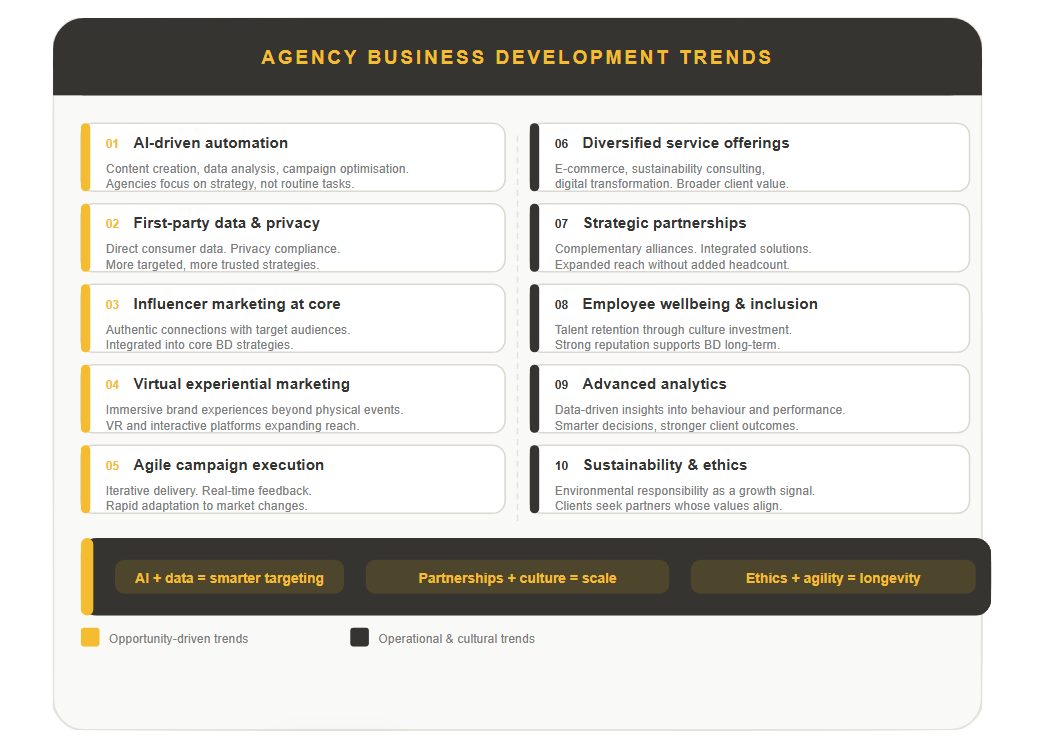
Agency business development is changing fast, pushed along by new technology, shifting client expectations and the way consumers now behave. For creative, digital, PR, experiential, shopper marketing and other communications agencies, keeping pace means paying attention to where the work is actually heading rather than where it has been. None of what follows is especially exotic, but the agencies that treat these shifts as background noise tend to find themselves scrambling to catch up a year or two later. Ten changes stand out at the moment, and together they paint a fairly clear picture of what winning and keeping clients will look like over the next few years.
- AI-driven automation is reshaping how agencies work. Artificial intelligence has moved from novelty to plumbing, handling routine tasks and supporting decisions across content production, data analysis and campaign optimisation. The practical effect is that teams spend less time on mechanical work and more on the strategic and creative thinking clients actually pay a premium for. The agencies pulling ahead are not the ones using AI to cut headcount, but the ones using it to do more with the people they already have.
- First-party data is becoming the priority. As privacy regulation tightens and third-party cookies fade, agencies are leaning on data gathered directly from a brand’s own audience. It is more compliant, more durable and usually more accurate, and it lets agencies build targeting that will still work when the regulatory ground shifts again.
- Influencer marketing is moving into the core strategy. What was once a bolt-on tactic now sits at the centre of many campaigns, because audiences trust a credible voice more readily than a brand talking about itself. PR and digital agencies in particular are weaving influencer partnerships into the main plan rather than treating them as an afterthought.
- Experiential is expanding into virtual spaces. Live events are no longer the limit of experiential work. Agencies are building immersive digital experiences using virtual reality and interactive platforms, which widens the creative palette and lets brands reach people who would never make it to a physical activation. The smartest work tends to blend the two, using a virtual layer to extend the life and reach of a live moment rather than replacing it.
- Agile ways of working are spreading to campaigns. Borrowing from software development, more agencies run campaigns in short, iterative cycles, building in real feedback and adjusting as they go rather than committing everything to a single big launch. It suits a market where conditions change faster than a traditional plan can keep up with.
- Service offerings are diversifying. To stay competitive, agencies are broadening what they sell, adding capabilities like e-commerce, sustainability consulting and digital transformation support. Widening the offer lets an agency solve more of a client’s problem and reduces the risk of being dropped the moment a need falls outside its original remit.
- Partnerships are filling capability gaps. Rather than building every skill in-house, agencies are forming partnerships with complementary firms and presenting clients with a joined-up solution. It is a faster, lower-risk way to extend reach and take on briefs that would otherwise sit out of range.
- Talent and culture are now a commercial issue. Agencies are taking employee wellbeing and inclusive cultures seriously, partly because the work is better when people are not burned out, and partly because reputation travels. Clients increasingly notice how an agency treats its own people before they trust it with their brand.
- Decisions are increasingly led by analytics. Advanced analytics is giving agencies a clearer read on consumer behaviour and campaign performance, which moves more of the decision-making from gut feel towards evidence. The agencies that can show what worked, and why, hold on to clients far more easily than those relying on assertion.
- Sustainability and ethics are becoming table stakes. Environmental responsibility and ethical practice now sit alongside creativity in how clients choose a partner. Brands under pressure to demonstrate their own values increasingly want to work with agencies whose standards match, which makes a credible position on sustainability a genuine commercial asset rather than a nice-to-have.
None of these shifts is a passing fad, and most of them reinforce one another. The agencies that read them early, and build the ones they believe in into how they actually operate rather than how they describe themselves, will be the ones still growing while the rest are wondering what changed.