Bringing in a new business agency is a significant investment and a genuine strategic decision for any marketing, creative, PR, digital or shopper marketing agency. Handing the reins of your business development to an outside team takes trust, collaboration and clear communication, and the results you get back are tied directly to how much you put in. A new business partnership is built on effort from both sides. Having worked with hundreds of agencies across different sectors, I have come to recognise the things that separate the engagements that fly from the ones that stall, and the ten that follow will help you get the most from the relationship.
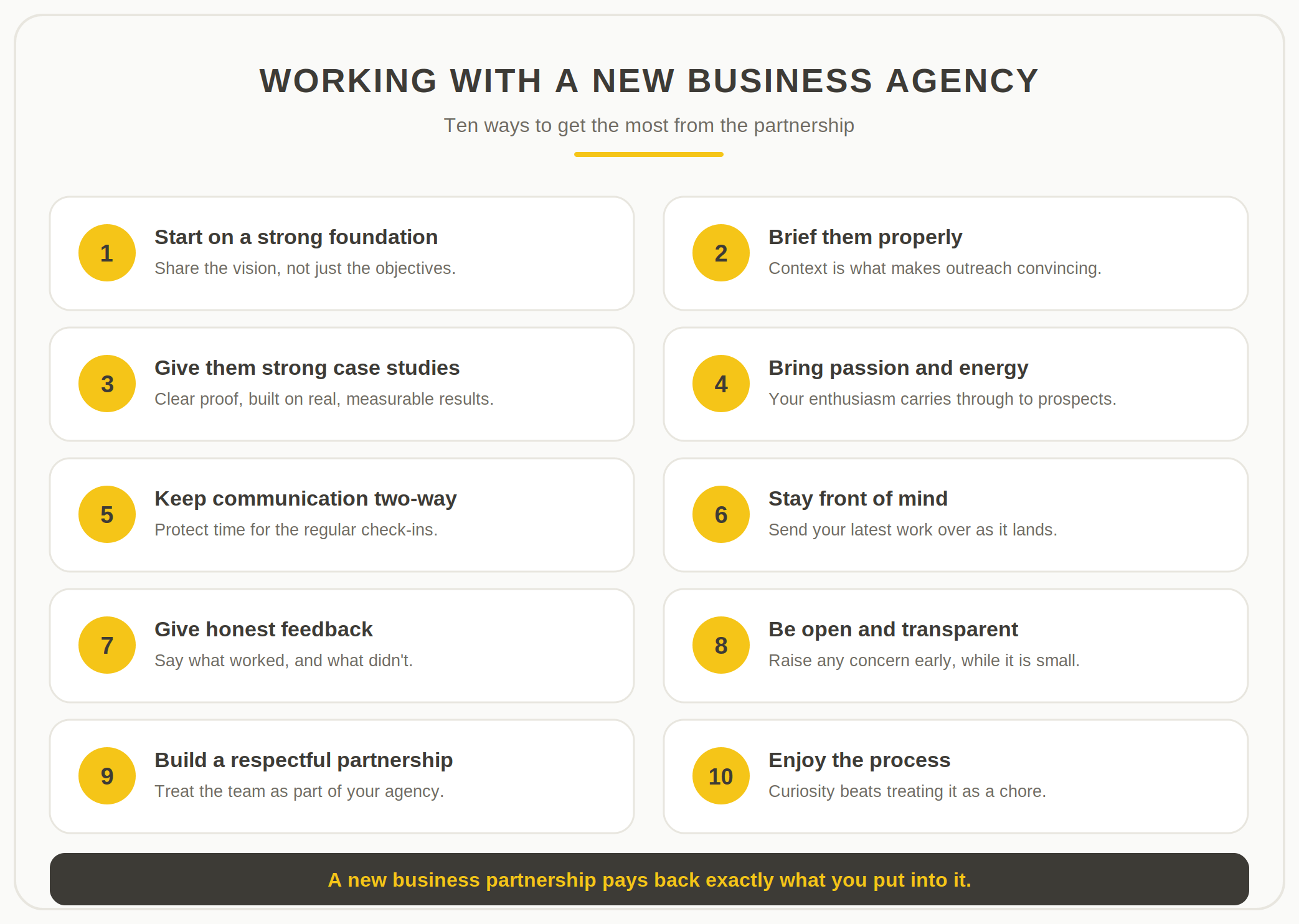
- Start on a strong foundation. The engagement is shaped in the first few days. You will have discussed your objectives before signing, but it pays to go further and share your long-term vision, how the agency is structured and what you are really trying to achieve. Treat your partner as an extension of your team rather than a supplier you have hired and then forgotten about.
- Brief them properly. Invest real time in inducting the team. Let them meet your key people and understand the agency from more than one angle, because the more context they carry, the more convincing their outreach becomes. A well-briefed caller who genuinely understands your ethos opens better doors than one working from a thin script.
- Give them strong case studies. Case studies are among the most useful sales tools you have. They prove the work and lend credibility to the pitch, so make sure yours are clear, well presented and built around quantifiable results. Your partner can advise on format, but a compelling success story does a lot of the heavy lifting.
- Bring passion and energy. Enthusiasm is contagious. The way you talk about your agency sets the tone for how the team talks about it to prospects, so take the time to articulate what actually makes you different. A caller who feels that energy passes it on, and that is what lands with decision-makers.
- Keep communication two-way. Your partner will send updates, but the relationship works best as a genuine exchange in both directions. Agencies too busy to take a regular check-in tend to get in their own way. Protect a little time for strategic conversation so the approach can be refined as you go rather than left to drift.
- Keep your agency front of mind. It is tempting to move straight on to the next project the moment a campaign wraps, but your latest work is exactly what keeps outreach fresh. Send it over. Regular updates mean prospects hear about your most recent wins and your agency keeps looking like a leader rather than a stranger.
- Give honest feedback. Feedback, good and bad, is what sharpens the approach. When a meeting goes well, say what worked. When it does not, say why. That insight is how the team learns what resonates with your prospects and refines the messaging for the conversations that follow.
- Be open and transparent. If something about the strategy, the messaging or the results is bothering you, raise it early. Your partner is there to help, but only if they know there is a problem. A transparent relationship deals with friction while it is still small, rather than letting it harden into a real obstacle.
- Build a respectful partnership. The best results come out of mutual respect. Treat the business development team as part of your agency rather than an outside cost, because a collaborative, positive environment produces better motivation, better work and a shared sense of ownership over the goal.
- Enjoy it. Winning new business should be a rewarding process rather than a chore. The agencies that get the most from it approach it with curiosity and openness, and in doing so they build relationships and momentum that pay off long after any single campaign. Engage fully and the partnership gives back far more than leads.
None of this is complicated, but it does ask something of you as well as your partner. Commit to these few habits and the relationship stops being a service you buy and becomes a genuine engine for growth, which is the difference between an agency that dabbles in new business and one that compounds it year after year.