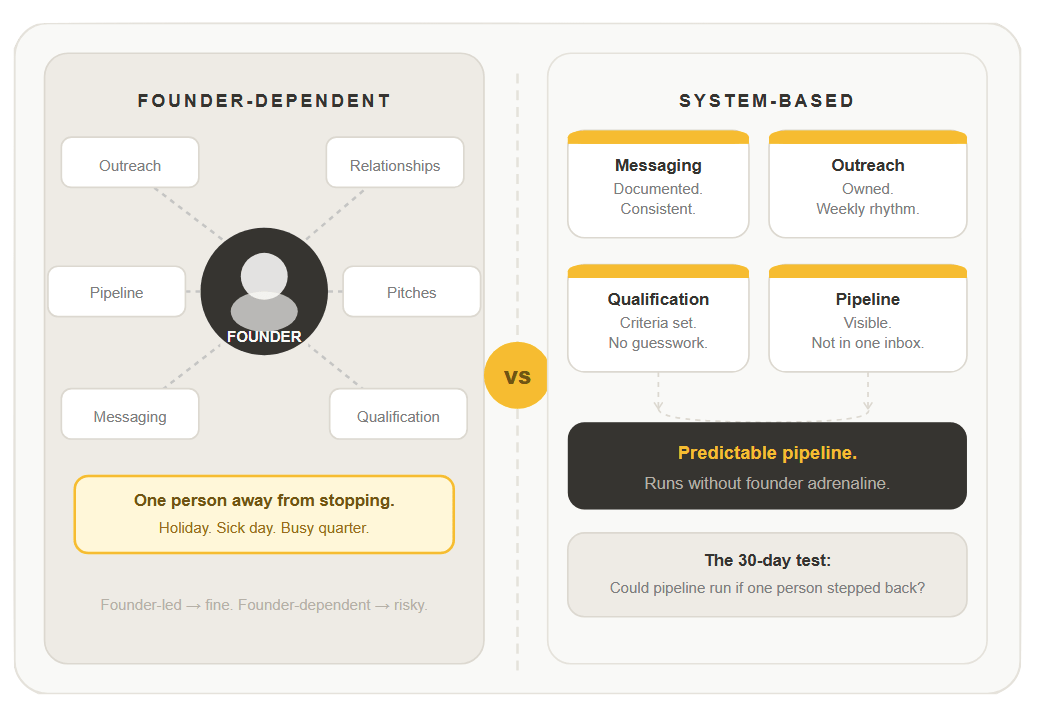
Founder-led sales is one of the most common phases in an agency’s life. In the early days it is usually the founder’s network, credibility and energy that drives the momentum. The founder knows the work best, tells the story best, and naturally becomes the person who brings opportunities through the door. There is nothing wrong with that. The trouble starts when founder-led sales quietly turns into founder-dependent sales, because at that point it has stopped being a stage the agency is passing through and become a structural risk it is carrying.
When growth rests on one person’s availability, relationships and constant effort, scale eventually slows. Not because the agency isn’t good enough, but because the machine was never built to run without the founder pushing every button. Sooner or later the cracks show. New business goes quiet the moment delivery gets busy, the pipeline dips whenever the founder takes a holiday, outreach happens in bursts rather than to a rhythm, qualification drifts from one conversation to the next, and revenue becomes hard to predict. An agency in that state is reacting rather than growing.
The Ceiling Of Founder-Dependent Growth. Most founders have no wish to be the bottleneck, but it tends to happen by degrees rather than by decision. They stay involved in every pitch, hold on to every relationship, and remain the only person who can really sell the work properly. Before long the agency cannot scale beyond what a single person is able to carry, and the weight of that lands everywhere at once, on delivery, on pricing, on the team, and on the founder personally. It also makes hiring, investment and any kind of long-term planning far harder than they ought to be. Growth that depends on heroic effort always finds a ceiling; growth that runs on a repeatable process does not.
Agencies That Scale Systemise Demand Generation. The agencies that move beyond founder-dependence rarely do anything dramatic. They build a system, and not a flashy or complicated one, just a consistent operating rhythm that produces pipeline without needing founder adrenaline to fuel it. In practice that means the messaging is written down rather than reinvented every quarter according to whatever feels urgent, outreach is genuinely owned by someone rather than left for whenever a spare hour appears, and qualification is applied the same way every time so the agency stops pouring effort into poor-fit opportunities. The pipeline lives somewhere the whole leadership team can see it rather than in one person’s inbox or head, and activity runs every week rather than only when a quiet patch forces it, because consistency is what compounds. That is how demand generation becomes predictable, and predictability is what makes scale possible.
Systems Protect Founders Rather Than Replace Them. Systemising demand generation keeps the founder in sales while taking the fragility out of it. The agency can carry on growing without the constant pressure, the last-minute panic, or the sense that everything hangs on one person’s energy holding up. The founder can stay as hands-on in selling as they want to be; what changes is that the business stops depending on it. Founder-led is a perfectly healthy place to be, and founder-dependent is the version of it that quietly puts the business at risk.
A Test For Any Leadership Team. It is a blunt one. Could your pipeline keep running if one person stepped back for thirty days? If the honest answer is no, the next stage of growth depends on more structure rather than more effort.