Most agency founders can point to their best clients and trace them straight back to a referral. Someone they worked with years ago moves to a new company and brings them in, a happy client mentions them over lunch, a partner agency passes on a brief that isn’t quite right for them. These are some of the easiest wins an agency ever gets. The trust has already been transferred, the prospect arrives half-sold, the sales cycle is short, and the close rate is high. There is no argument to be had about whether referrals are valuable, because they plainly are.
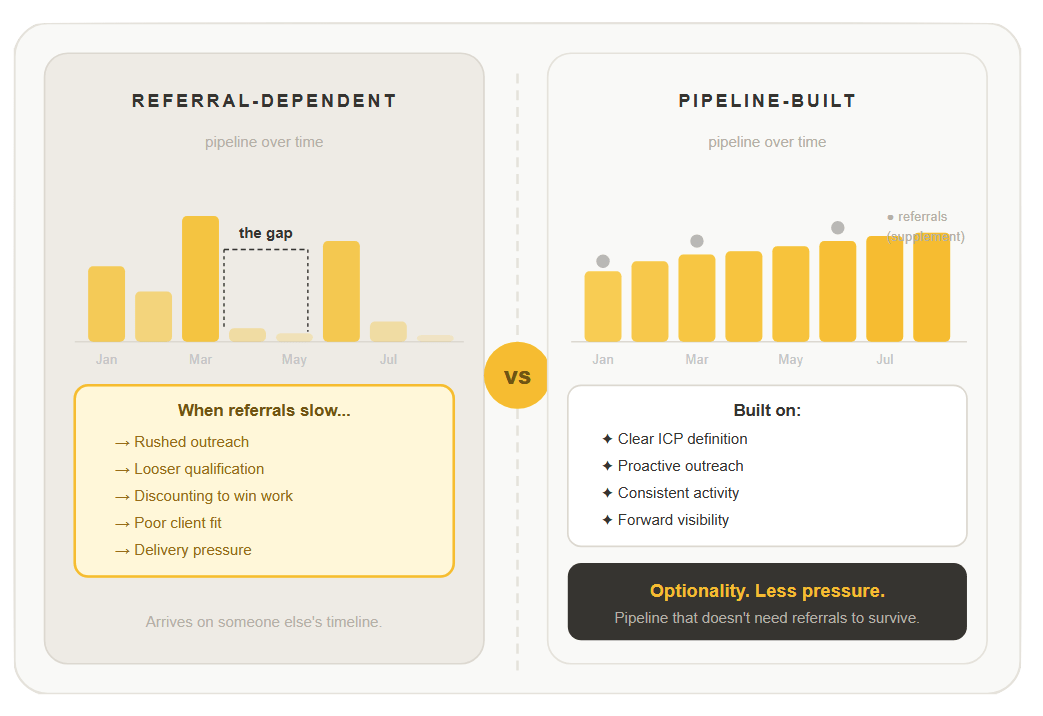
Referrals Can’t Be Forecast Or Scaled. The difficulty is what happens when an agency quietly starts treating them as the plan rather than a bonus. A referral cannot be forecast, because it depends on someone else remembering you at the exact moment a need appears in front of them. It cannot be scaled, because there is no lever you can pull that reliably produces more of them. And it arrives entirely on someone else’s timeline, which means the months when you most need new work are not necessarily the months when referrals decide to show up. A pipeline built on that foundation is reactive by design. It responds to whatever the market happens to send rather than being shaped by the agency itself.
The Cost Of A Quiet Quarter. The fragility tends to stay invisible while the referrals keep coming, then reveals itself all at once when they slow. A quiet quarter triggers a familiar chain of compromises. Outreach that should have been running all along gets switched on in a hurry, so it is rushed and rarely lands well. Qualification loosens, because suddenly any conversation feels better than none, and the agency starts entertaining prospects it would normally have walked away from. Discounting creeps in to win deals that were never quite a fit, margins take the hit, and the delivery team inherits clients who were a stretch from the start. None of these are isolated mistakes. They are the predictable symptoms of a pipeline that only moves when someone outside the business decides to feed it.
What Resilient Agencies Build Instead. Agencies with durable growth do not abandon referrals, and they certainly do not turn their noses up at a warm introduction. They simply stop asking referrals to carry the whole load, and let them sit on top of a pipeline the agency owns and controls. That core pipeline rests on a handful of unglamorous disciplines. There is a clearly defined ideal client profile, so the agency knows exactly who it is trying to reach and why. There is proactive outreach to those companies, run consistently rather than in panic bursts. The activity is measured at the input level, so the agency can see how many conversations it is starting and what is moving through each stage rather than guessing. And there is forward visibility, a view of the pipeline several months out that lets leadership plan with some confidence instead of reacting to the latest swing.
Optionality Is The Real Prize. When an agency has a pipeline it can rely on, it gets to choose. It can turn down poor-fit work without panicking about the gap it leaves. It can hold its pricing, because it is not negotiating from a position of need. It can hire ahead of demand rather than scrambling once the work has already landed, and it can shield the delivery team from the feast-and-famine swings that wear people down over time. Optionality is what separates an agency that is in control of its growth from one that is permanently bracing for the next quiet month. Referrals, valuable as they are, give you none of that on their own, precisely because you cannot choose when they arrive.
The Honest Test. Picture the warm introductions drying up for a stretch. If referrals stopped tomorrow, an agency built on a proactive, owned pipeline would carry on much as before, while one quietly depending on goodwill would feel the floor move beneath it. The first has treated referrals as the gift they are. The second has mistaken a gift for a system, and that difference only becomes obvious once the gift stops coming. Building the pipeline before you need it is what turns referrals back into what they should always have been, a welcome addition to growth that was never resting on them in the first place.