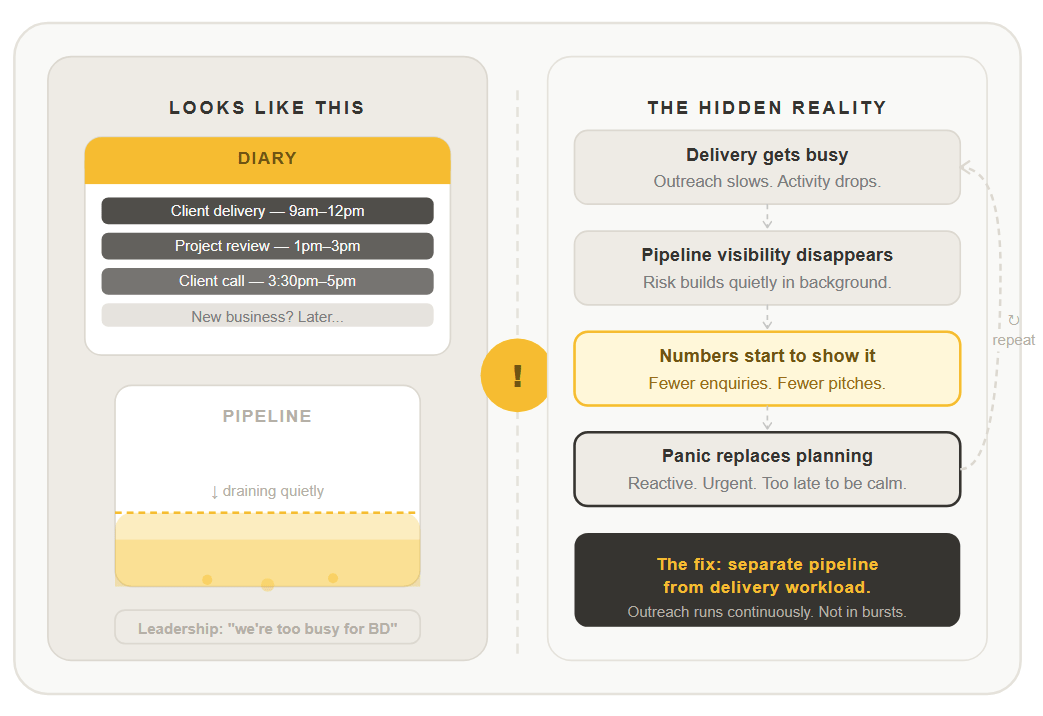
Plenty of agency owners read a full diary as proof that things are going well. The delivery team is stretched, the calendar is packed, and there is a steady hum of work moving through the building. It feels like control. What it often hides is how little anyone can see beyond the next few weeks. Busyness and security are not the same thing, and some of the most exposed agencies are the ones running flat out. When everyone is buried in client work, it is easy to assume new business is looking after itself, right up until the point it clearly isn’t.
The Hidden Risk Of Delivery Peaks. The pattern is a familiar one. Delivery gets heavy, outreach slows, new business activity tails off, and pipeline visibility quietly disappears. Leadership relaxes, because the current month looks fine. The trouble is that pipeline doesn’t fall over the moment outreach stops. It falls over later, after weeks of nothing much happening in the background while everyone’s attention is on deadlines and capacity. By the time the gap shows up in the numbers, in fewer enquiries, fewer conversations, fewer live opportunities, there is no calm way left to respond. Agencies in that position don’t plan their way out. They scramble.
Why This Happens So Often. Delivery is urgent in a way that new business rarely feels. Client work has deadlines and teams have hard limits on what they can take on, so servicing the retainer always wins. Outreach gets filed under “when things calm down,” and things almost never calm down. New business becomes reactive, the pipeline turns lumpy, and growth ends up resting on a burst of last-minute effort. That is a rhythm problem rather than a capability one.
Secure Agencies Separate Pipeline From Workload. The agencies that actually feel stable have stopped tying new business to how full the diary happens to be. They keep outreach running whether delivery is quiet or slammed, qualify leads early rather than when they are desperate for work, and start conversations months before they need the capacity. That gives them a view of the pipeline three to six months out, which is what lets a leadership team plan instead of react. The stability comes from that visibility, not from the volume of work in front of them today.
Predictability Creates Healthier Teams. When nobody can see the pipeline clearly, the business starts running on anxiety. A quiet month triggers panic outreach, the work lands and overloads delivery, outreach stops because everyone is heads-down, and the pipeline dips again a few weeks later. Founders carry the weight of fixing it each time, teams get whiplashed between famine and overload, pricing softens whenever there is pressure to close something, and client fit slips because almost anything starts to look worth taking. A predictable pipeline removes most of that. It gives an agency room to hire on purpose, invest with some confidence, and shield the delivery team from the constant swings.
A Simple Test For Leadership Teams. If nothing new came in for the next sixty days, how comfortable would you be? If that question makes you wince, what you are short of is visibility, and no amount of extra workload will paper over it. Agencies that build pipeline steadily, ahead of need, don’t just grow faster. They grow with far less pressure on everyone involved.
Build Pipeline That Doesn’t Depend On Busy. At Manifest we build the outbound systems that keep that pipeline filling regardless of how busy the delivery team is, so new business stops depending on last-minute hustle and starts running months ahead of where you actually need it.