Every creative, digital, PR or marketing agency understands that content should be part of how it wins new business. The catch is that consistent output and useful output are not the same thing. Publishing regularly does lift visibility, but visibility alone does not land clients, and agencies that start producing content without a clear strategy behind it rarely see it turn into real opportunities. To make content actually work for new business, you have to go past the obvious: create distinctive, insight-led material that genuinely speaks to your ideal audience, then put it in front of them with real precision. Content will not win a pitch on its own, but used well it sparks conversations, opens doors and warms up prospects long before your business development team picks up the phone.
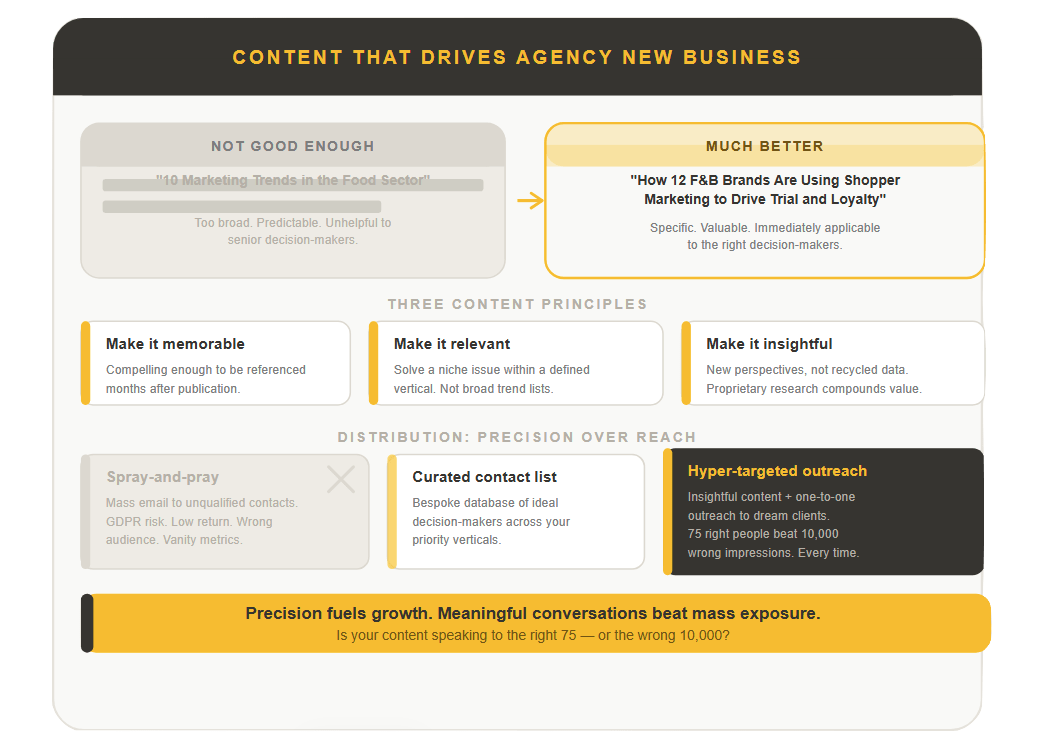
Create Content That Wins Clients. Three things separate content that earns attention from content that disappears into the feed. The first is memorability: a piece worth publishing is one people still reference and share months later, because if your audience never talks about it, they are unlikely to buy from you. The second is relevance to a real, specific problem rather than a broad theme. Compare a generic “Ten Marketing Trends in the Food Sector”, which is too predictable to hold a senior decision-maker’s attention, with something like “How Twelve Food and Beverage Brands Are Using Shopper Marketing to Drive Trial and Loyalty”, which is immediately useful to a marketing lead in that exact category. The third is genuine insight. The content that underpins months of outbound activity is built on fresh thinking or proprietary research rather than recycled data, and while that costs more to produce, a single standout study can power outreach for a long time.
Twelve Topics That Spark Conversations With Decision-Makers. The best content ideas come from your clients and prospects, not from guesswork, so the simplest place to start is asking what they wish someone would explain. If you are not sure where to begin, these prompts will get your team to useful territory:
- What challenges are your clients facing that their current partners are not addressing?
- What themes keep appearing in recent RFPs?
- What are you hearing in webinars and pitch feedback?
- Where are the gaps between what clients want and what agencies actually deliver?
- What emerging technology or shift in consumer behaviour do your prospects need to navigate?
- What data are prospects missing to make a confident marketing decision?
- Which strategies are working across more than one category?
- What is failing in your prospects’ current campaigns?
- Which KPIs are clients struggling to move?
- How are market leaders in retail, B2B or experiential adapting?
- What is the role of earned media now for brands that used to lean on paid?
- How are in-house teams managing their creative output, and where do they need help?
Distribute With Precision, Not Volume. How you distribute content matters as much as the content itself, and a single blanket method rarely works. Four approaches are worth weighing against each other:
- Avoid spray-and-pray. Mass-emailing thousands of unqualified contacts rarely produces qualified leads, and under GDPR a wave of unsubscribes can shut down your future outreach entirely. If you are emailing at volume, the content has to be tightly targeted and genuinely useful.
- Build a handpicked list. Curate a bespoke database of the marketing decision-makers in your priority verticals. It is slow work, but it lifts your hit rate and gets your content to the people it was written for.
- Use PR for visibility, but do not lean on it. PR can build reputation and reach a wider audience, but you give up control over who actually sees it. Treat it as a long-term brand play rather than a quick source of new business.
- Focus on hyper-targeted outreach. The most effective route is to pair insightful content with one-to-one outreach to your dream clients, using the content as a natural reason to make contact: a quick note that you have just published a study on how FMCG brands are transforming experiential campaigns and thought it would be relevant. Even if only seventy-five people read it, those are the seventy-five you actually want, which beats ten thousand impressions from the wrong audience.
If the goal is better-fit clients, content has to be wired into your new business strategy rather than running alongside it. Broad topics and vanity metrics will not get you there. Specific, valuable insight delivered straight to the people who matter will, because in agency new business a handful of meaningful conversations is worth far more than mass exposure to the wrong room.