As advertising, creative and PR agencies push harder to win new clients, a lot of them are weighing up how far AI should go in their new business. The pitch is familiar: speed, efficiency and lower costs. The real question is whether it can carry the nuance and personal touch that winning agency work actually depends on. Here is where AI genuinely helps, and where it quietly lets you down.
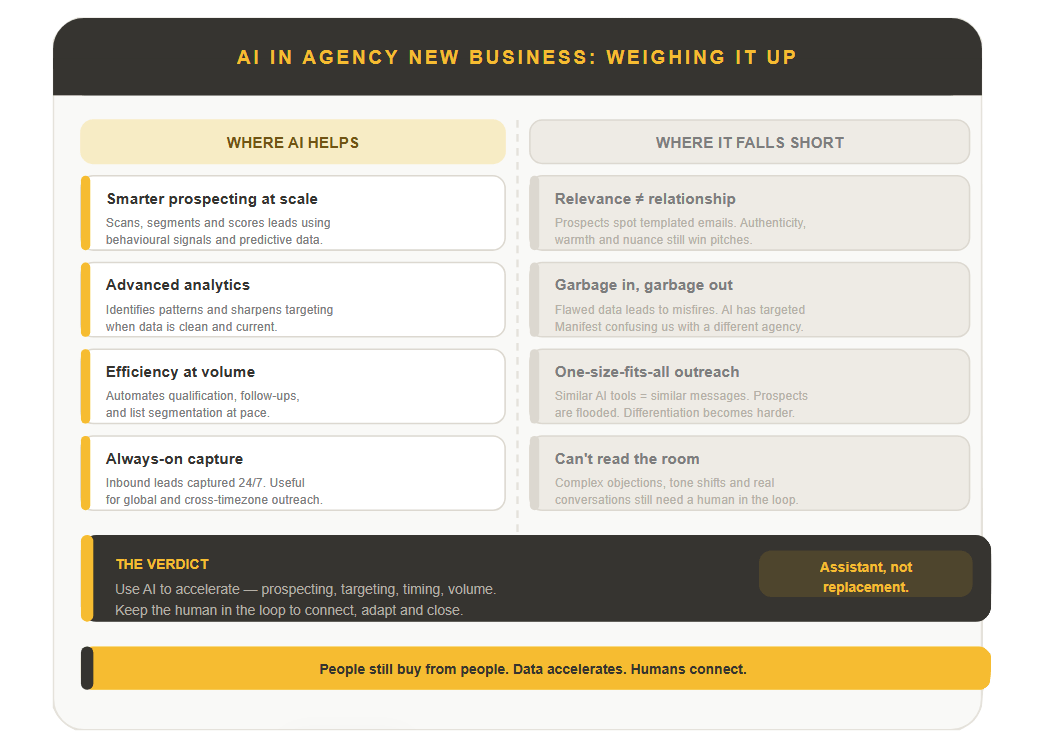
- Smarter prospecting, within limits. AI can scan, segment and score leads at speed using behavioural signals, digital footprints and predictive data, which lets a team concentrate on the prospects most likely to convert. It is not foolproof, though. Feed it poor data and it misfires. We have been targeted repeatedly by AI email campaigns that confuse us with a famous PR agency of a similar name, which is both useless to us and quietly damaging to the sender, especially when the entire pitch is how clever their technology is.
- Relevance without relationship only goes so far. AI can tailor messages from browsing behaviour and data, which should lift engagement. In practice, agency prospects spot a templated email from a long way off. The campaigns that land tend to rely on warmth, nuance and a bit of improvisation, and those are exactly the qualities automation still struggles to fake convincingly.
- Analytics are only as good as the data. AI is genuinely strong at crunching numbers and finding patterns, which sharpens targeting and informs better decisions. All of it depends on clean, current data, though. An outdated database turns that power into wasted effort and poor-quality conversations, whereas a person can adapt on the spot. A two-minute phone call often tells you more about a prospect than any algorithm will.
- Efficiency at scale, until things get complicated. AI takes real work off your plate, handling qualification, follow-ups and list segmentation, which matters when outreach volumes are high. The moment a conversation gets complex or a prospect pushes back, it runs out of road. A chatbot is no substitute for an experienced business development lead who can tailor a pitch, read a room and field an awkward question on the fly.
- The one-size-fits-all problem. As more agencies adopt the same tools, outreach starts to converge. Prospects receive near-identical messages with near-identical subject lines, and cut-through drops accordingly. That saturation makes standing out harder, particularly for boutique creative shops and specialist PR firms whose whole appeal is being different. A person can pivot tone or angle in a way the tools cannot yet manage.
- The limits of always-on. AI does not sleep, so inbound leads can be captured and answered around the clock, which helps for global campaigns and across time zones. Availability only takes you so far in B2B, though. Prospects still expect a considered reply rather than a robotic autoresponder, and a fast non-answer can do more harm than a slower, thoughtful one.
- Integration is rarely seamless. Done well, AI in your CRM promises tidy data syncing and a single clear view of every lead journey. Done badly, it does the opposite. Plenty of agencies find these platforms do not play nicely with legacy CRM setups, and the result is duplication, confusion and fresh data silos rather than fewer of them.
- Legal risk and compliance. Any agency using AI for lead generation has to stay the right side of data protection law, GDPR included. Many systems operate globally and make little allowance for regional rules, which means the duty to stay lawful and transparent sits squarely with your own team rather than the vendor.
- Cheaper now can cost you later. The savings are usually the headline attraction, since automation trims headcount and lifts productivity. The risk is that what you save in cash you lose in connection. A well-timed call, a properly tailored proposal or a face-to-face meeting still closes deals in a way that automated sequences rarely do.
- AI works best in a supporting role. In the end, people still buy from people. AI earns its place helping with timing, volume and targeting, but winning creative and PR work still turns on a personal approach. The setup that works pairs smart automation with human judgement, insight and the flexibility to respond to whatever the conversation throws up.
AI is not going anywhere, and for agency new business it opens up real opportunities. The best results will keep coming from the same combination, though: data-driven tools doing the heavy lifting on volume and timing, with experienced people supplying the sector knowledge, emotional read and relationships that actually win the work. Use AI to accelerate, and keep a human in the loop to connect.