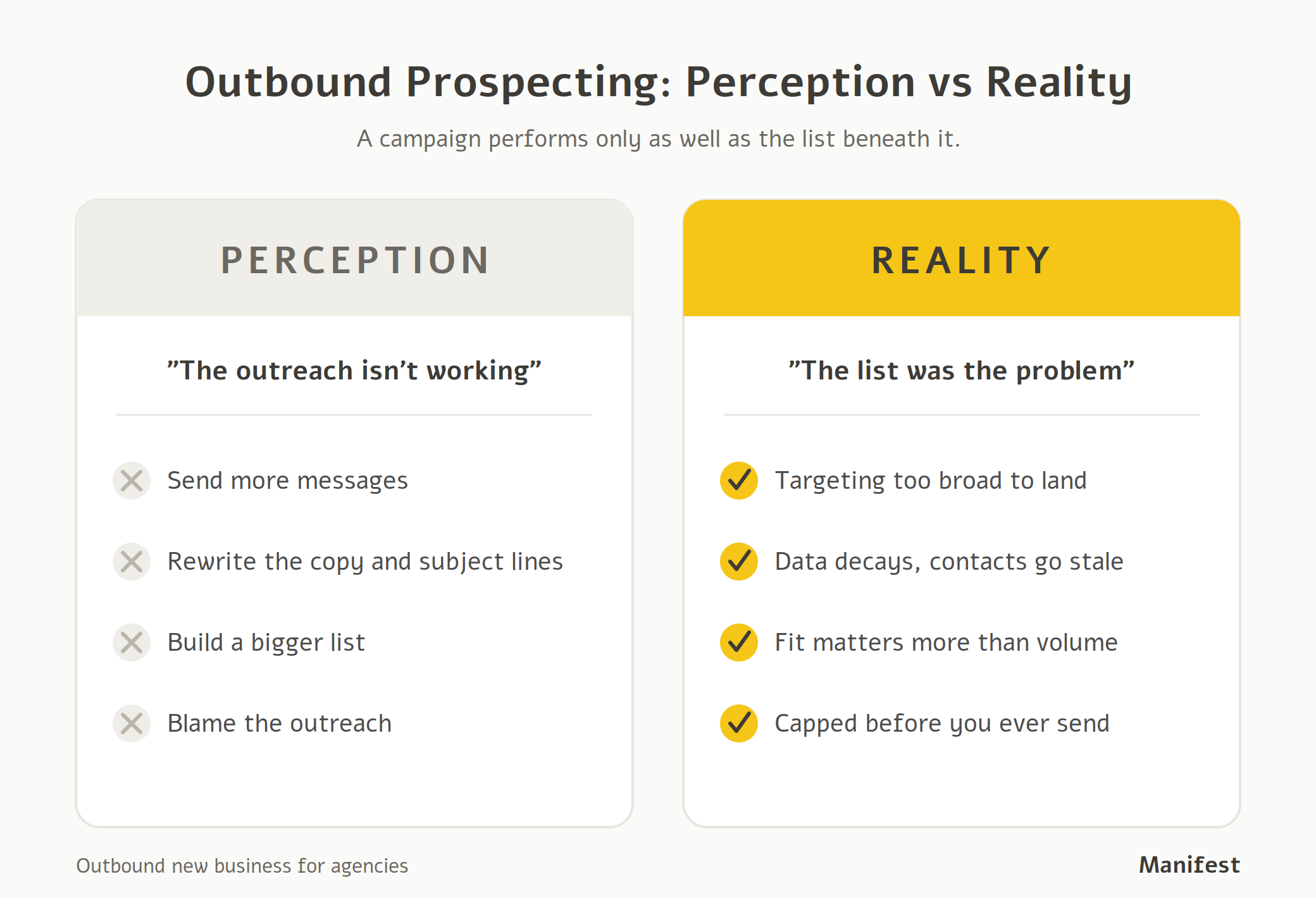
Outbound prospecting fails for most agencies long before the first message is sent, because the lead list it relies on was built on guesswork rather than evidence. A campaign can only ever be as good as the names feeding it, and a list of loosely relevant companies will quietly cap every result that follows. The agencies that win consistently from outbound treat list building as the real work and the outreach itself as the easy part. These are the seven challenges that hold most agency prospecting back, and the practical ways to fix each one.
1. The List Targets Everyone, So It Reaches No One
The most common outbound prospecting mistake is a list defined so broadly that no message on it can feel relevant. Any brand that might need marketing is an audience, not a target. When a list spans every sector, size and maturity at once, the messaging has to flatten to fit all of them, and generic messaging is the surest route to being ignored. The fix is a tightly drawn ideal client profile that names the sectors you genuinely win in, the company sizes that can afford your work, and the situations that make an agency like yours an obvious choice. A smaller, sharper definition feels counterintuitive when pipeline is thin, yet it is the single change that lifts relevance, reply rates and meeting quality at the same time. Decide who the list is not for, and the rest becomes far easier to build.
2. The Data Is Sourced Once and Left to Rot
A lead list is a living asset, and most agency lists fail because they are treated as a one-off download. Contact data decays fast, with people changing roles, companies restructuring and email addresses lapsing within months. A list pulled from a single database a year ago is now part fiction, and every bounce and wrong number on it chips away at sender reputation and confidence. Strong lead list building layers sources rather than leaning on one, combining a core database with enrichment, verification and a light manual check on the accounts that matter most. Bounce rates stay low, the people you reach are the people you meant to reach, and the campaign keeps its credibility with the inbox providers that quietly decide whether you land at all.
3. The List Names Companies, Not Decision-Makers
Reaching the right company is worthless if the message lands with the wrong person inside it. Agency buying decisions rarely sit with a single, obvious contact. A marketing manager may feel like the natural target while the budget and the appetite actually sit with a founder, a marketing director or a head of growth, and a campaign aimed one level too low stalls in inboxes that were never able to say yes. Mapping the buying unit before the list is finalised, then prioritising the contacts who can both recognise the problem and authorise the spend, turns a directory of company names into a list of people who can act. The same outreach, pointed at the right seniority, performs on a different level entirely.
4. There Are No Disqualification Rules
A qualified outbound list is defined as much by who it excludes as by who it includes. Most agencies build lists by adding everyone who looks vaguely plausible, which loads the campaign with prospects who were never going to buy. Companies with a capable in-house team, brands that have just appointed an agency, and firms too small to fund the work all absorb effort that could have gone to live opportunities. Clear disqualification rules, applied before a single message goes out, strip those names away early. Cutting a list down to the accounts that can realistically buy is one of the highest-return moves in business development campaigns, because every hour of outreach then lands on someone who can actually become a client.
5. Volume Is Mistaken for Progress
Outbound sales challenges multiply the moment volume becomes the goal in its own right. A list of several thousand thinly researched contacts feels like momentum, yet it almost always underperforms a few hundred well-chosen ones. High volume forces generic messaging, drives low acceptance and reply rates, and burns through the domain and profile reputation that takes weeks to rebuild. The better measure is fit, not headcount. A focused list lets each message carry a genuine reason for landing, which lifts the metrics that matter, and a healthy reply rate from a smaller audience will always beat a flood of contacts who never engage. Restraint at the list stage is what makes the outreach that follows look effortless.
6. The List Ignores Timing and Buying Signals
The strongest sales outreach strategies reach the right company at the moment it is most likely to act. A static list treats every prospect as equally ready, when in practice readiness moves constantly. New funding, a leadership hire, a brand relaunch, a public agency review or a sudden surge of category growth all signal that a company may be in the market now rather than someday. Layering these triggers over the core list, and prioritising the accounts showing them, turns prospecting for agencies from cold interruption into timely relevance. The message can stay the same while the timing changes the response entirely. Signal-led targeting is what separates outreach that feels intrusive from outreach that arrives just as the need becomes real.
7. Nothing Learned From One Campaign Feeds the Next
A lead list should get sharper with every campaign, yet most are rebuilt from scratch each time. When a campaign ends, the intelligence it generated, the sectors that replied, the titles that engaged, the messages that opened doors, usually evaporates instead of improving the next list. Without that feedback loop, the same broad targeting and the same weak segments repeat indefinitely. Treating outbound prospecting as a system means feeding every result back into the criteria, retiring the segments that never convert and doubling down on the ones that do. Over a few cycles the list stops being a guess and becomes a model of exactly who responds, which is the point at which outbound stops feeling like a gamble and starts producing predictable pipeline.
None of these challenges are solved by sending more. They are solved earlier, in the decisions about who belongs on the list and why, because outbound prospecting only ever performs as well as the targeting beneath it. Build the list with the same care you would give a pitch, and the campaign will reward you for it.
Frequently Asked Questions
Why do agencies struggle with outbound prospecting?
Agencies struggle with outbound prospecting mainly because the lead list is built too broadly and maintained too little. Targeting is set so wide that messaging cannot be relevant, contact data decays without enrichment, and there are rarely clear rules for who to exclude. The outreach is then blamed for results that were capped by the list long before any message was sent.
What makes a good outbound lead list for an agency?
A good outbound lead list is narrow, current and decision-maker led. It is built from a tightly defined ideal client profile, sourced from layered and verified data rather than a single download, and pointed at the people senior enough to authorise the work. Strong lists also exclude prospects who cannot realistically buy, which concentrates every campaign on accounts that can become clients.
How can agencies improve outbound campaign performance?
Agencies improve outbound campaign performance by fixing targeting and list quality before touching the messaging. That means tightening the ideal client profile, prioritising accounts showing buying signals such as new funding or leadership changes, keeping volume low enough to stay relevant, and feeding each campaign’s results back into the next list so the targeting sharpens over time.